
Understanding Pain, Scans, and Why Your Spine Is Probably Less Fragile Than You Think
Part II
What many people do not realise is how strongly the brain and nervous system influence pain. Stress, anxiety, poor sleep, work pressure, fatigue, and fear around movement can all amplify pain signals. The brain reacts not only to actual tissue damage, but also to perceived damage/injury and/or danger. Which essentially means you do not always need a major injury to experience significant pain, and sometimes relatively minor irritation can produce surprisingly high pain levels if the nervous system becomes overprotective.
A stressed and exhausted body is often a more sensitive body (meaning your brain can sometimes turn the “pain volume knob” up or down independently of how much actual tissue damage is present — confusing, I know). In other words, pain levels do not always perfectly match the amount of tissue damage present, which feels deeply unfair but is incredibly common.
This is why physiotherapy is not just about exercises or massages. Good rehabilitation is also about education, reassurance, confidence-building, and helping people trust their bodies again. The aim is often to reduce the nervous system’s overprotective response, helping your brain realise that movement is safe again, so it stops reacting to every movement like it’s an emergency.
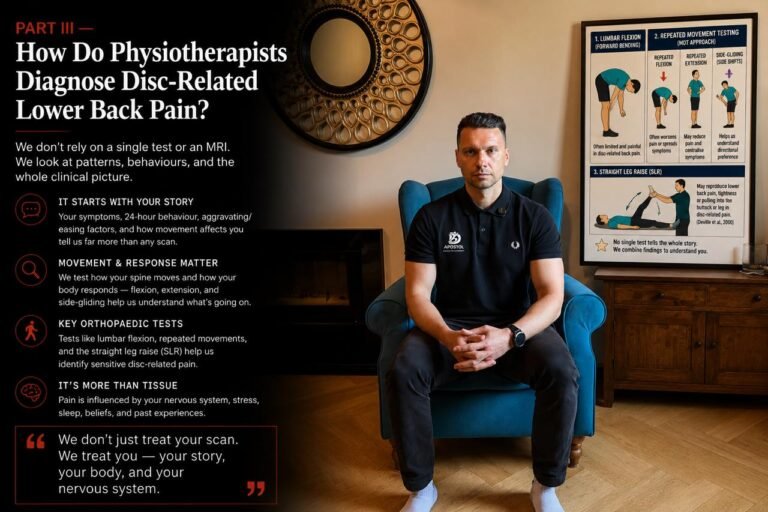
This is also why scans are not always necessary! However, in a very small percentage of cases — such as significant nerve compression, inflammatory conditions, fractures, infections, or more serious pathology — medical investigations are important and appropriate (and this is usually where a physiotherapist can help: identifying when symptoms are simply part of a common back pain episode versus when further investigation might actually be needed — which thankfully is much less common-less than 4% of total back pain cases in the UK). But for the vast majority of people, early scans are often unhelpful and sometimes even increase anxiety unnecessarily by showing perfectly normal age-related findings.
A proper clinical assessment and understanding of symptoms are usually far more valuable than simply chasing imaging results. In fact, I often spend a large part of the session reassuring patients that their scan findings are common age-related changes and not proof that their back has suddenly aged 40 years overnight.
One of the biggest things I try to help patients with is reducing fear around movement and giving them clarity about what is actually happening. Back pain can feel incredibly discouraging, especially when it starts affecting sleep, work, exercise, or confidence. Sometimes people simply need reassurance that they are not “damaged,” alongside a structured plan to regain strength, mobility, and confidence again.
Having gone through my own recent flare-up reminded me just how emotional and mentally draining pain can sometimes become. But it also reminded me how resilient the human body truly is. Most people recover very well, especially when they stay active, remain patient with the process, and avoid falling into the trap of fearing every movement.
So if you are currently struggling with back pain, try not to panic. Your back is stronger than you think, and recovery is very rarely about finding one magical stretch, one perfect posture, or one expensive gadget from the internet promising to “fix” your spine forever. I always find this slightly amusing! Despite billions spent on back pain research worldwide, we still haven’t ‘cured’ back pain — yet apparently a £29.99 posture gadget from social media has finally solved it. More often, recovery comes from understanding your pain better, moving gradually and confidently again, improving lifestyle factors, and allowing the body time to settle.
And of course, if you feel unsure about what is causing your symptoms or you simply need guidance through recovery, I am always happy to help. A proper assessment, reassurance, and a personalised rehabilitation plan can often make the process feel far less overwhelming and help you return confidently to normal life again.
Your back is not fragile. Sometimes it is just a little overprotective — and occasionally a bit dramatic.
Thank you for taking the time to read this — and hopefully your back now feels slightly less mysterious and dramatic than it did at the beginning of the blog. But, if you still wonder when or if you should see a physiotherapist with your acute/persistent back pain, then progress to the next level/blog and hopefully you will find your answer. (PS: If you’ve made it this far, genuinely impressive. Modern attention spans usually collapse somewhere around paragraph three)