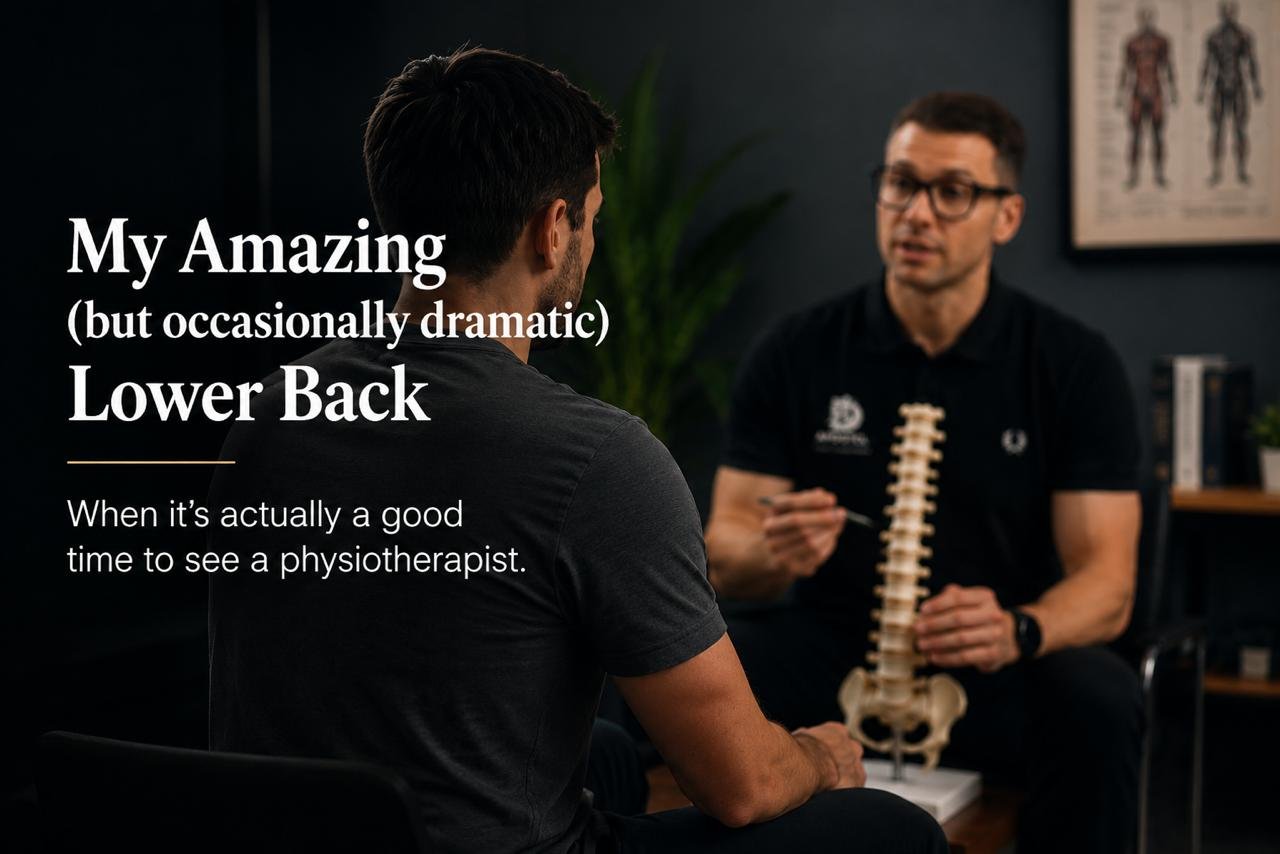
When Is It Actually a Good Time to See a Physiotherapist?
Part III
After reading the first two parts, you might now be thinking:
“Okay… so my spine is probably not collapsing, I should keep moving, avoid panic-Googling at 2am, and stop treating my back like fragile IKEA furniture (apologies to Ikea). But when should I actually see a physiotherapist?”
And honestly, that’s a very reasonable question.
If you tend to be a naturally anxious person, seeing a physiotherapist early can actually be incredibly helpful in starting the reassurance process before your highly imaginative brain convinces you that one awkward bend has permanently ended your athletic career, gym membership, and ability to load the dishwasher. While most episodes of back pain improve well with time, movement, and reassurance, there are absolutely situations were having proper guidance early can make recovery smoother, faster, and significantly less stressful.
Seeing a physiotherapist early is less about “fixing damage” and more about understanding what is happening, reducing fear, making sure symptoms are behaving as expected, and helping you recover confidently rather than cautiously. In many cases, people seek help because they are scared rather than seriously injured — and honestly, that is completely understandable. Pain can feel frightening, especially when simple movements suddenly become difficult.
Frankly, I would much rather you invest in one proper physiotherapy session with a detailed assessment and a good education session than spend the next few weeks catastrophising every time you bend down to pick something up. Most acute back pain episodes settle within a few weeks, especially if you remain gently active and avoid complete rest. But that does not mean you need to spend three miserable weeks trying to “walk it off” while moving around the house like you’re carrying an invisible fridge on your back.
A good physiotherapy assessment can often provide clarity and reassurance very quickly. Most patients that I meet with acute and chronic back pain usually want to know whether their symptoms are likely to be serious, whether they should keep moving, whether they need a scan, why pain sometimes changes location, why mornings or night feel worse, or whether walking and exercising are helping or making things worse. This is where a good physiotherapist can genuinely help.
By looking at your specific presentation, detailed history, lifestyle factors, movement patterns, and overall assessment findings, they can usually provide clarity, reassurance, and answers to most of those questions rather than leaving you to negotiate them alone with Google at midnight. The earlier people understand their pain properly, the less likely they are to fall into fear, avoidance, excessive rest, or the dangerous internet rabbit hole where every symptom somehow ends with “you probably need surgery immediately.”
Chronic back pain, however, is often a very different experience altogether. By that point, many people are not just dealing with pain anymore. They are dealing with months — sometimes years — of frustration, poor sleep, reduced confidence, deconditioning, stress, conflicting advice, failed treatments, and MRI reports containing enough dramatic terminology to convince anyone their spine is crumbling in real time. This is where physiotherapy becomes much more than simply handing somebody a sheet of exercises.
Because chronic pain is rarely just about tissues alone anymore. Very often, the nervous system itself has become hypersensitive and overprotective. The body almost starts expecting pain before movement even happens. People begin avoiding bending, lifting, gym work, travelling, gardening, or sometimes even normal daily activities because they no longer trust their back. Ironically, this is usually where the real cycle begins. Less movement often leads to more stiffness, more fear, more sensitivity, and eventually more pain.
A large part of physiotherapy in chronic back pain is therefore helping people slowly rebuild trust in their body again. At this stage, it is usually safe to say that recovery is rarely a simple “one session and fixed” type of situation, but rather a more gradual and individual process based around your unique pain behaviour, lifestyle, movement confidence, stress levels, physical capacity, and previous experiences with pain. Of course, this always starts with a thorough and detailed assessment, proper history taking, and making sure that the more serious conditions briefly discussed in Part II have been appropriately ruled out first.
And importantly, recovery is usually not achieved through magical “alignment corrections,” miracle posture gadgets, or somebody aggressively elbowing your spine for 45 minutes while claiming to “release toxins.” And to be clear, I am not attacking anyone’s preferred treatment choices here — if something relaxes you or makes you feel temporarily better, great.
Just understand that long-term recovery usually involves much more than passive treatments alone. More often, meaningful long-term progress comes through education, reassurance, gradual exposure to movement, sensible progression, strength-building, and helping calm down an overprotective nervous system.
So, going back to our initial question: “When is the right time to see a physiotherapist?”
My favourite answer is usually: *sooner than most people think*.
Not because every episode is serious — thankfully, most are not — but because good guidance early on can reduce anxiety, improve confidence, keep people active, and sometimes stop relatively minor issues from slowly becoming long-term problems fuelled by fear, uncertainty, and avoidance.
And if symptoms are persistent, recurring, or starting to significantly affect your sleep, work, gym training, mental health, or overall quality of life, that is usually a very reasonable point to seek help. You do not need to wait until you can barely move.
And equally, you do not need to panic because your back complained after a weekend of ambitious DIY decisions and eight hours of “quick gardening.”
Sometimes people simply need reassurance. Sometimes they need a plan. Most of the time, they need both. Because the truth is that most backs are not weak, most people are not damaged, and most movement is far safer than people think. The human body is incredibly adaptable. Sometimes it just needs guidance, reassurance, and a little patience along the way.
And if your back has recently decided to become unnecessarily dramatic, you do not have to navigate it alone. I am here and I would love to help you!
PS: If you actually read Parts I, II, and III properly, you may now officially diagnose yourself with an unusually healthy attention span.