
A More Honest, Reassuring, and Less Dramatic Look at Back Pain
Part I
I decided to write about back pain because, despite being one of the most common complaints in the UK, it’s still surrounded by myths, fear, and advice that sounds like it came from your neighbour’s uncle in 1987. After hearing the same misconceptions from patients over the years, I thought it might be useful to break things down in a simpler, more human way.
This will be a two-part blog series and, hopefully, somewhere along the way, both your back — and your anxiety about it — will feel a little better.
Back pain has a remarkable ability to appear at the most inconvenient times. Usually when you are finally motivated to get back into the gym, after a long drive, or while attempting something extremely dangerous… like bending down to pick up a sock( this is a joke-bending down and putting your socks on it’s the most natural and normal human movement). One awkward movement later and suddenly you’re moving around the house like your back has just submitted its resignation letter.
The reassuring news is that you are far from alone. Around 80–90% of people will experience lower back pain at some point in their lives, and despite how frightening or frustrating it can feel in the moment, most episodes improve significantly within a few weeks.
What makes back pain so interesting — and sometimes confusing — is that it is not always directly linked to serious damage or injury. A plethora of research has shown us that pain is far more complex than simply finding one “damaged structure” on a scan. In fact, many people with completely pain-free backs will still show disc bulges, degeneration, or arthritic changes on MRI scans (a sentence that tends to confuse patients and occasionally offend their MRI report).” A bit like wrinkles on the skin, some changes are simply part of being human rather than proof that your spine is “broken.”
A few months ago, I had my own episode of acute low back pain. It was sharp, restrictive, frustrating, and humbling all at the same time. Even as a physiotherapist, there is something strangely unsettling about feeling pain every time you try to roll in bed or put your shoes on. For a brief moment, even I caught myself moving cautiously and overthinking simple movements. But interestingly, it also reminded me of something I often tell my patients every day in clinic: pain does not necessarily mean harm.
Experiencing it personally reinforced how powerful reassurance, movement, and understanding really are (although, admittedly, it’s much easier to give reassurance than to take your own advice). It also reminded me how much fear and uncertainty can influence recovery. When pain appears suddenly, people naturally become protective. They stop bending, twisting, exercising, and sometimes even walking normally because they are worried about “making it worse.” The body, however, is much stronger and more adaptable than most people realise.
The spine is not fragile. It is one of the strongest structures in the human body, designed to bend, rotate, absorb load, and adapt to movement throughout life. Most episodes of back pain fall into what we call “non-specific low back pain,” which essentially means there is no serious structural problem causing the symptoms. Instead, pain is often the result of several factors working together: stiffness, muscle tension, stress, poor sleep, reduced movement, overload, or sometimes simply doing too much too soon after doing too little for too long. The classic “I haven’t trained in six months but today I decided to reorganise the garage and deadlift furniture” scenario. Or, as I often hear from patients every spring: ‘The garden suffered all winter, but this was my only free weekend to make it look nice again… so I decided to do eight hours of digging, lifting, and bending in one go.’”
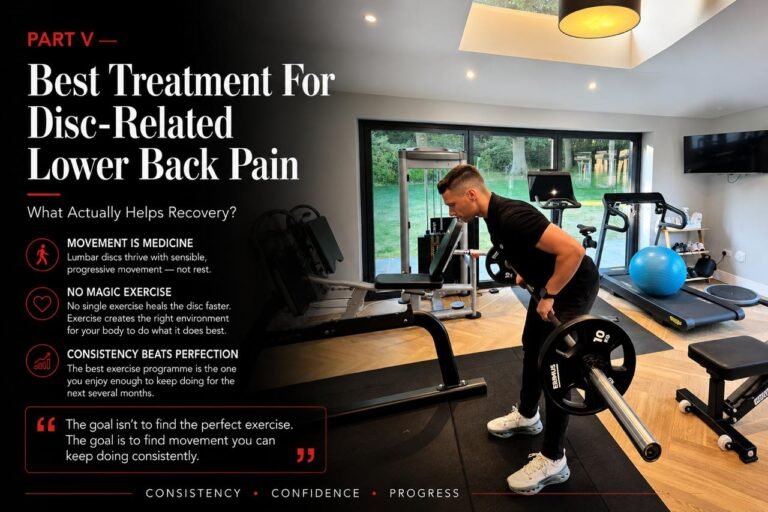
One of the most important things we know from modern evidence is that movement is one of the best treatments for back pain (I know this can sound difficult to believe during the first 48 hours when putting socks on feels like an extreme sport, but keeping gently active genuinely helps recovery). Every major guideline — including NICE guidelines in the UK — strongly encourages people to stay active. While short periods of relative rest can help during very acute pain, prolonged rest and “protecting the back” too much often slows recovery down. Gentle movement helps restore confidence, improve circulation, reduce stiffness, calm the nervous system, and remind the brain that movement is safe again.
That does not mean forcing yourself through severe pain or pretending nothing hurts. Recovery is usually about gradual exposure and sensible progression rather than heroic gym montages with motivational music in the background. Walking, swimming, mobility work, yoga, strength training, or simply returning gradually to normal daily activities can all play an important role In fact, recent research suggests that walking, swimming, strength training, yoga, and mobility work all tend to help in fairly similar ways. The best exercise is usually the one you actually enjoy enough to continue doing after three days.
In Part 2, we’ll look at the relationship between stress, the nervous system, scans, MRI findings, and why understanding pain properly can sometimes be just as important as treating it.