Disc Bulge, Disc Pain & Lower Back Pain
What Disc-Related Low Back Pain Actually Feels Like — And Why Your MRI Is Usually Less Scary Than It Sounds
This is a 5-part blog series where we are going to discuss disc-related lower back pain properly — from what discs actually are, to why MRI reports occasionally sound like your spine has entered its final life stage despite you simply struggling to put your socks on comfortably.
Now, before we start, an important clarification: this conversation is mainly focused on the discs in the lower back (lumbar spine), although many of the same principles overlap with: neck disc pain and neck pain with arm symptoms, because discs, nerves, pain, movement, and human overthinking unfortunately tend to collaborate quite closely.
We will cover:
- what disc pain actually feels like,
- why scans often sound scarier than reality,
- how physiotherapists assess disc-related pain,
- why pain can travel into the leg without necessarily being “trapped nerves,”
- how long disc injuries usually take to improve,
- and what modern evidence-based rehabilitation actually looks like.
And perhaps most importantly: we are going to discuss why the overwhelming majority of people with disc bulges are significantly more robust than they initially believe.
So… buckle up, adjust your lumbar support if it makes you emotionally happy, and let’s begin!
This article is Part I of a five-part series on disc-related lower back pain. At the end of each article, you’ll find a link to continue to the next part.
Part I — My MRI Says I Have a Disc Bulge. Should I Panic?
It probably feels like I’m starting this conversation from the middle rather than the beginning. Instead of first explaining what discs are, how disc pain behaves, and why lumbar discs occasionally become sensitive, I’m jumping straight into your MRI report. The main reason for that is simple: the vast majority of patients I see have already visited a GP, spinal consultant, osteopath, chiropractor, physiotherapist, Google, Reddit, three YouTube spinal gurus, and occasionally one emotionally devastating Facebook group before they see me ( I might have exaggerate there a bit).
And by the time they finally sit in front of me, the first sentence is usually: “I have a disc bulge. ”Not: “My back feels stiff. ”Not: “I’ve been struggling with bending. ”Not even: “My lower back hurts.” Straight away: “I have a disc bulge.”As if the MRI finding itself has now become their entire identity.
So let’s start this blog with something important: Your disc is probably not the villain in this story! Yes — disc-related back pain can hurt. Sometimes a lot. Sometimes a lot , a lot !
Sometimes enough to make putting socks on feel like an Olympic qualification event.
But please continue reading because hopefully by the end of this blog I might persuade you that your lumbar discs are not evil structures designed specifically to ruin your happiness, destroy your gym career, and emotionally destabilise you every time you sit down for too long. In fact, discs are remarkably important, adaptable, resilient structures that spend their entire existence trying to help your spine tolerate movement, compression, bending, lifting, walking, running, twisting, and surviving modern life.
Also, you have probably already spent the last 5 minutes sitting down reading this blog, so this is your gentle reminder to stand up, walk around for a minute, rotate a bit, maybe stare dramatically out of the window while pretending to contemplate your lumbar spine. More about this later when we discuss treatment.
Ok, now that your mini break is over, let’s address the giant emotionally charged elephant in the room: your MRI report telling you that you have a disc bulge.
One of the most important spinal imaging studies ever published demonstrated that disc bulges and degeneration are astonishingly common even in completely pain-free individuals (Brinjikji et al., 2015).
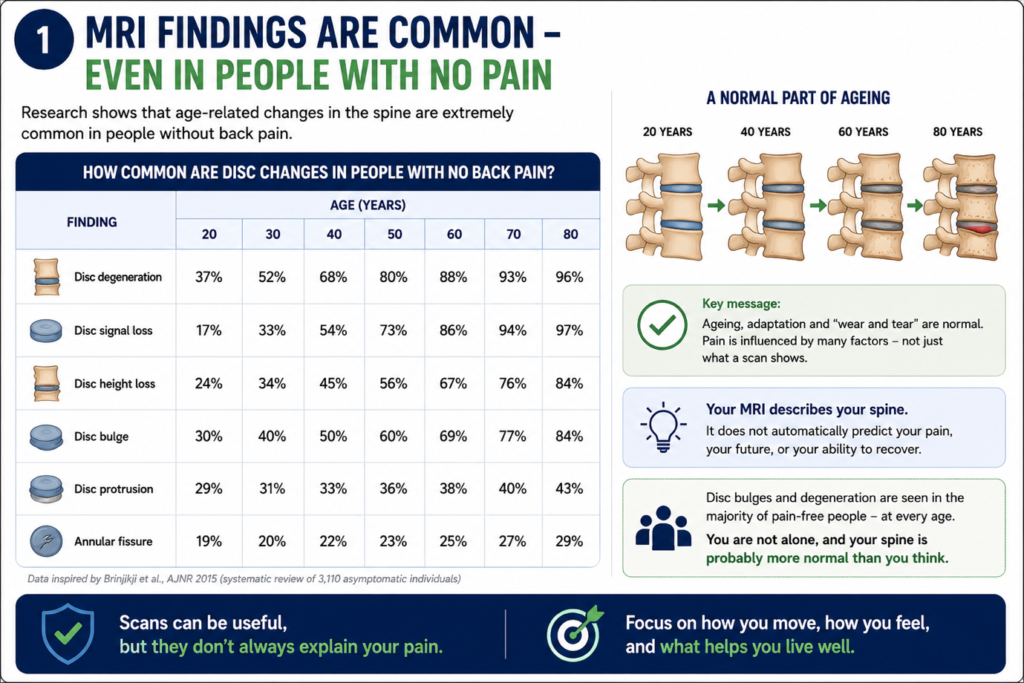
Which means many people walking around: travelling, lifting, exercising, gardening, running, deadlifting, sitting badly, and generally ignoring all spinal advice given on Instagram already have disc bulges without even knowing it ( and hopefully they will not have to learn about it ).
Lumbar disc bulges were also extremely common in asymptomatic individuals:
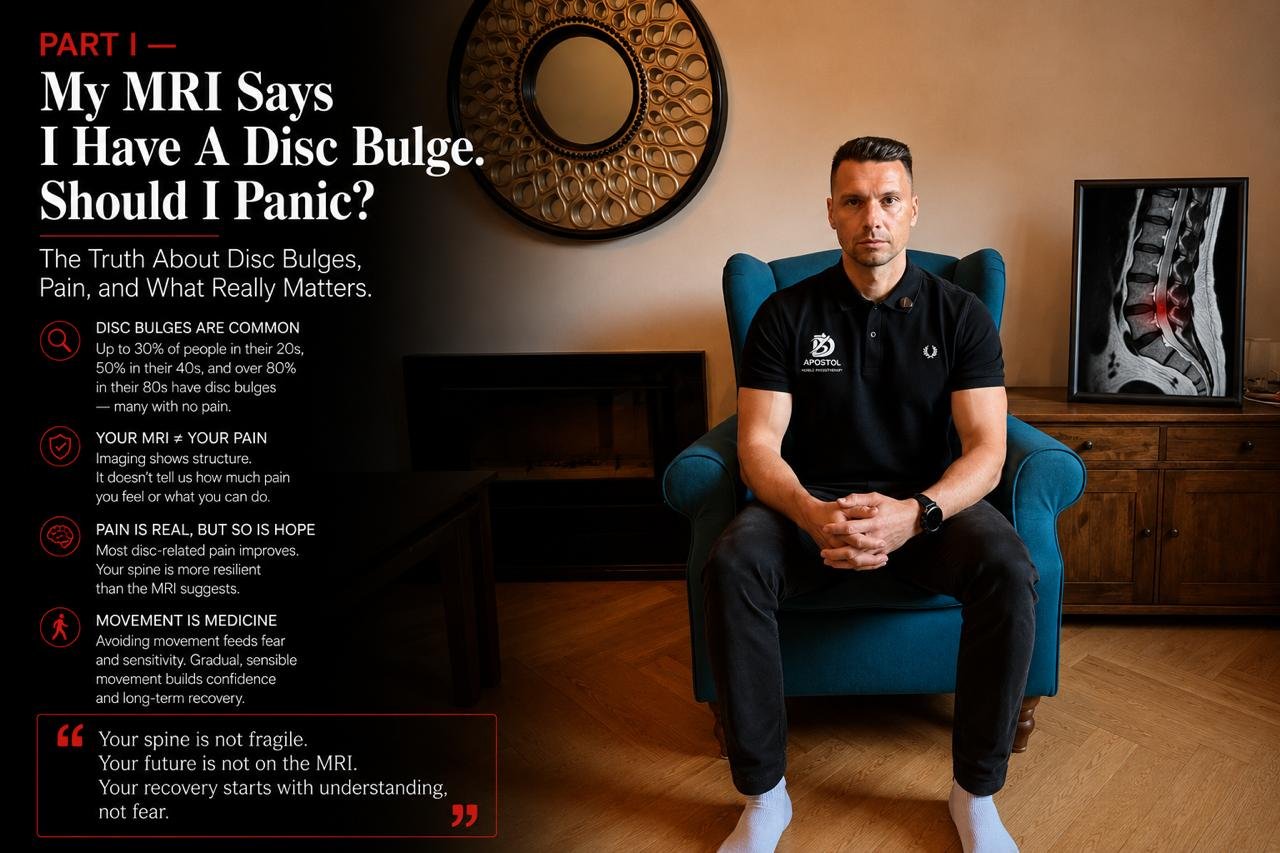
- roughly 30% in people aged 20,
- approximately 50% by age 40,
- and over 80% by age 80 despite many having no lower back pain whatsoever (Brinjikji et al., 2015).
Unfortunately, MRI reports occasionally describe normal age-related spinal changes with the emotional intensity of a disaster documentary. Terms like:
- disc degeneration,
- annular tear,
- protrusion,
- extrusion,
- desiccation,
- or “multilevel degenerative changes”
have an incredible ability to convince otherwise rational human beings that their lumbar spine is quietly collapsing in real time. And honestly, this fear is understandable.
Disc-related lower back pain can feel severe. A lumbar disc bulge can feel severe.
And when lower back pain becomes severe, the human brain understandably starts asking: “Have I permanently damaged my spine?” Thankfully, the answer is usually: “Probably not! Most likely not !”
Ok.I feel like now it’s a good time to get back on track and explain what discs are.
Intervertebral discs are remarkable structures. They act as shock absorbers between the vertebrae of the lumbar spine, helping distribute load, absorb force, and allow the back to move throughout life. Unfortunately, much like knees, shoulders, skin, hairlines, and almost all other biological structure humans possess, spinal discs also age over time (hopefully gracefully like you, dear reader) . And modern research has repeatedly shown that lumbar disc degeneration and disc bulges are astonishingly common — even in people with absolutely no lower back pain whatsoever.
Human lumbar discs accumulate mileage over time. That is normal. This is one of the biggest themes repeatedly discussed by Butler and Moseley in modern pain science literature: structural findings and pain are often related, but they are certainly not the same thing (Butler & Moseley, 2013; Moseley, 2003). In other words: your lumbar MRI describes your spine. It does not automatically predict your pain, your future, or your ability to recover from disc-related back pain.
And honestly, this distinction matters enormously because fear surrounding MRI findings often becomes one of the biggest drivers of ongoing chronic lower back pain itself. People begin to: avoid movement, fear bending, stop exercising, become hypervigilant, lose confidence, and start treating their spine like fragile glassware rather than a strong adaptable structure. Ironically, this protective behaviour often sensitises the nervous system even further and can prolong lower back pain substantially (Vlaeyen et al., 2018).
And honestly, I have seen this behaviour in an extraordinary number of patients over the years. Which is completely understandable.
After a severe episode of disc-related pain, the back suddenly stops feeling: strong
and starts feeling unpredictable, even, dare I say it ,weak L
People become cautious around bending. They move differently. They brace constantly. They avoid lifting. They stop exercising. Sometimes they even become afraid of normal daily activities like putting shoes on, picking something from the floor, or sitting for too long. And I can tell you from clinical experience: one of the hardest parts of rehabilitation is not always calming the pain itself —it is helping somebody trust their back again after the body has scared them properly once.
Because severe pain changes behaviour. Sometimes instantly. And unfortunately, once fear enters the equation, the nervous system often becomes significantly more protective, sensitive, and over-alert around movement, loading, and spinal flexion — even after the tissues themselves have already started settling down.( you can read more about pain and sensitivity here – https://apostolmobilephysiotherapy.com/pain-your-bodys-most-misunderstood-alarm-system-2/)
Continue Reading
→ Part II: What Does Disc-Related Lower Back Pain Actually Feel Like?