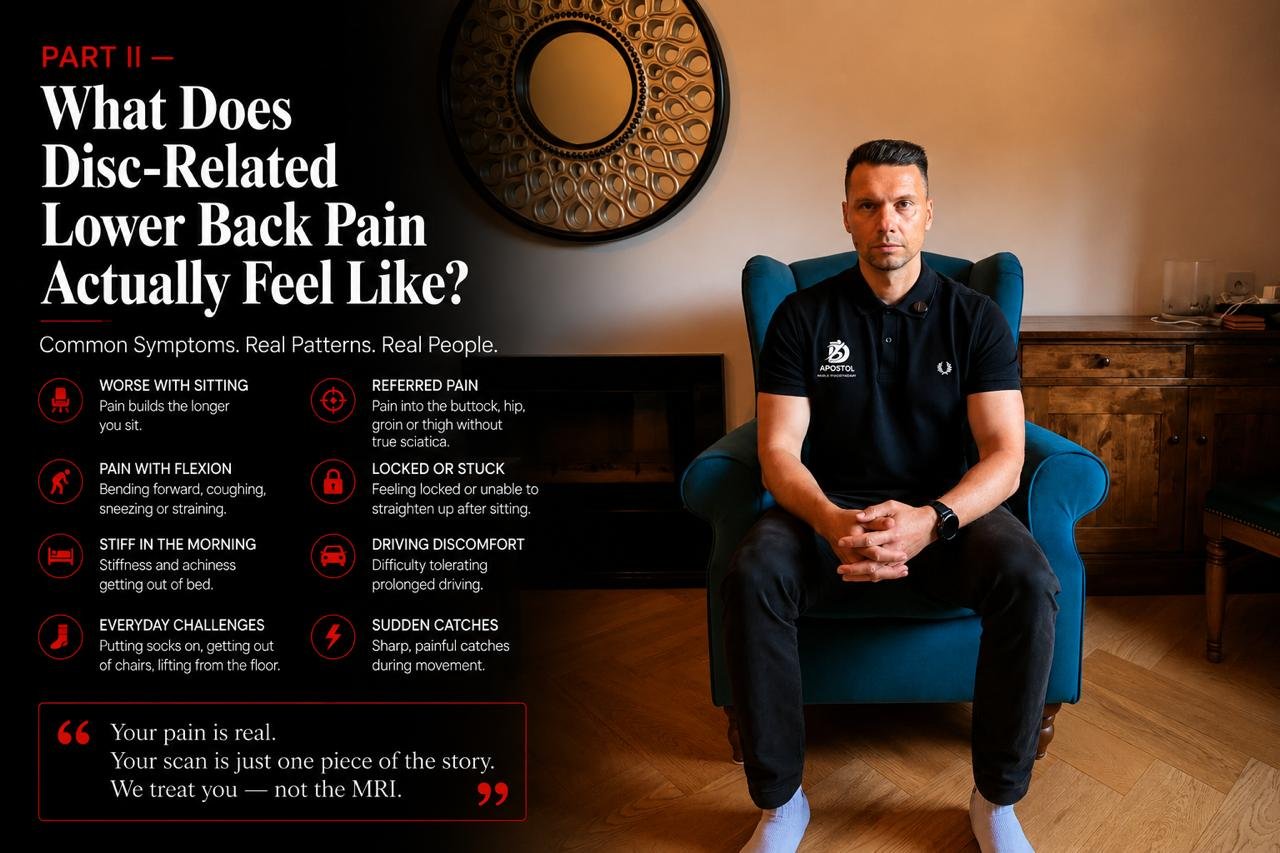
Discogenic low back pain and lumbar disc pain often follow a surprisingly recognisable clinical pattern. As you will see in part III disc related back pain is a clinical diagnoses- meaning generally we don’t need an MRI to diagnose discogenic low back pain. There are some clues/symptoms that patients will commonly describe:
- lower back pain sitting for prolonged periods,
- increased pain with couching ,sneezing and/or straining on the toilet ( and occasionally with laughing),
- stiffness getting out of bed,
- pain bending forward,
- difficulty putting socks on,
- discomfort getting out of chairs,
- pain lifting from the floor,
- or symptoms worsening after prolonged sitting or repeated spinal flexion.
- feeling “locked” or unable to straighten up properly after sitting
- sudden painful “catches” during movement,
- difficulty tolerating prolonged driving,
- intermittent gluteal pain,
- occasional referred pain into the thigh without true sciatica,
- And many more symptoms …
Many people also describe a very specific phenomenon: “I feel okay initially… then the longer I sit, the angrier my lower back becomes.” And honestly, this pattern makes biomechanical sense because sitting and repeated spinal flexion can increase loading and pressure through the posterior lumbar disc structures (Peng et al., 2023; Knezevic et al., 2021). This is one reason lumbar disc pain is often referred to as “flexion intolerant” lower back pain.
Interestingly, one of the most misunderstood concepts in low back pain is that pain can travel surprisingly far away from the lumbar spine without nerves necessarily being trapped.
Bogduk’s work on somatic referred pain demonstrated that lumbar discs can refer pain into: the buttock, lateral hip, groin, posterior thigh, and occasionally further down the leg without true sciatica or lumbar nerve root compression being present (Bogduk, 2009).
Which means: not every pain in the leg is sciatica. And importantly: not every lumbar disc bulge is trapping a nerve. This distinction matters enormously clinically because true lumbar radiculopathy and sciatica behave quite differently from ordinary discogenic referred pain, and can have a different recovery time and potentially different treatment pathways.
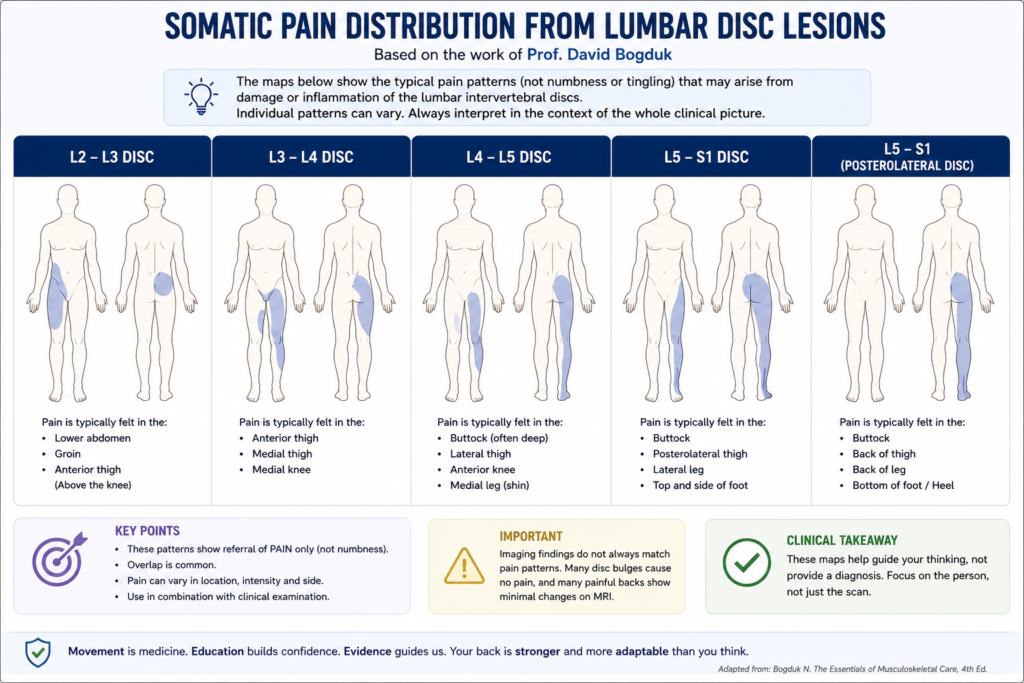
One of the most fascinating things about disc-related pain is how variable it can be. Some people mainly experience stiffness. Others mainly experience sharp movement pain. Some experience severe spasms. Others mainly describe a constant deep ache that feels like the lower back is permanently irritated. Some have predominantly central lower back pain. Others develop referred symptoms into the buttock, lateral hip, groin, or leg. Some patients report that sitting significantly aggravates symptoms while walking actually makes them feel better. Others experience the exact opposite: walking becomes irritating, standing feels uncomfortable, and sitting temporarily feels easier.
And honestly, this variability is one of the reasons lower back pain can become so confusing — both for patients and occasionally for clinicians as well. Because discs, muscles, joints, nerves, the immune system, movement patterns, stress, sleep, previous injuries, physical conditioning, fear, and nervous system sensitivity all interact together in one large beautifully complicated lumbar orchestra. Which unfortunately means the spine does not always follow the simple predictable rules people desperately want it to follow.
Human biology rarely reads the textbook before developing symptoms.
Continue Reading
← PART I My MRI Says I Have A Disc Bulge. Should I Panic?
→ PART III How Do Physiotherapists Diagnose Disc-Related Lower Back Pain?