This is probably the section most people care about the most. (And if you skipped directly to this part, I will not fault you.)
Fortunately, modern treatment for lumbar disc pain and disc-related lower back pain is usually far less dramatic than people expect and, in most cases, very effective (although I might be slightly biased based on the patients I’ve seen so far).
For most patients, evidence-based physiotherapy treatment involves: education, reassurance, sensible movement, progressive strengthening, walking, gradual loading, sleep optimisation, confidence-building (or perhaps confidence restoring), and helping the nervous system become less protective over time (Maher et al., 2017; Foster et al., 2018; Hartvigsen et al., 2018).
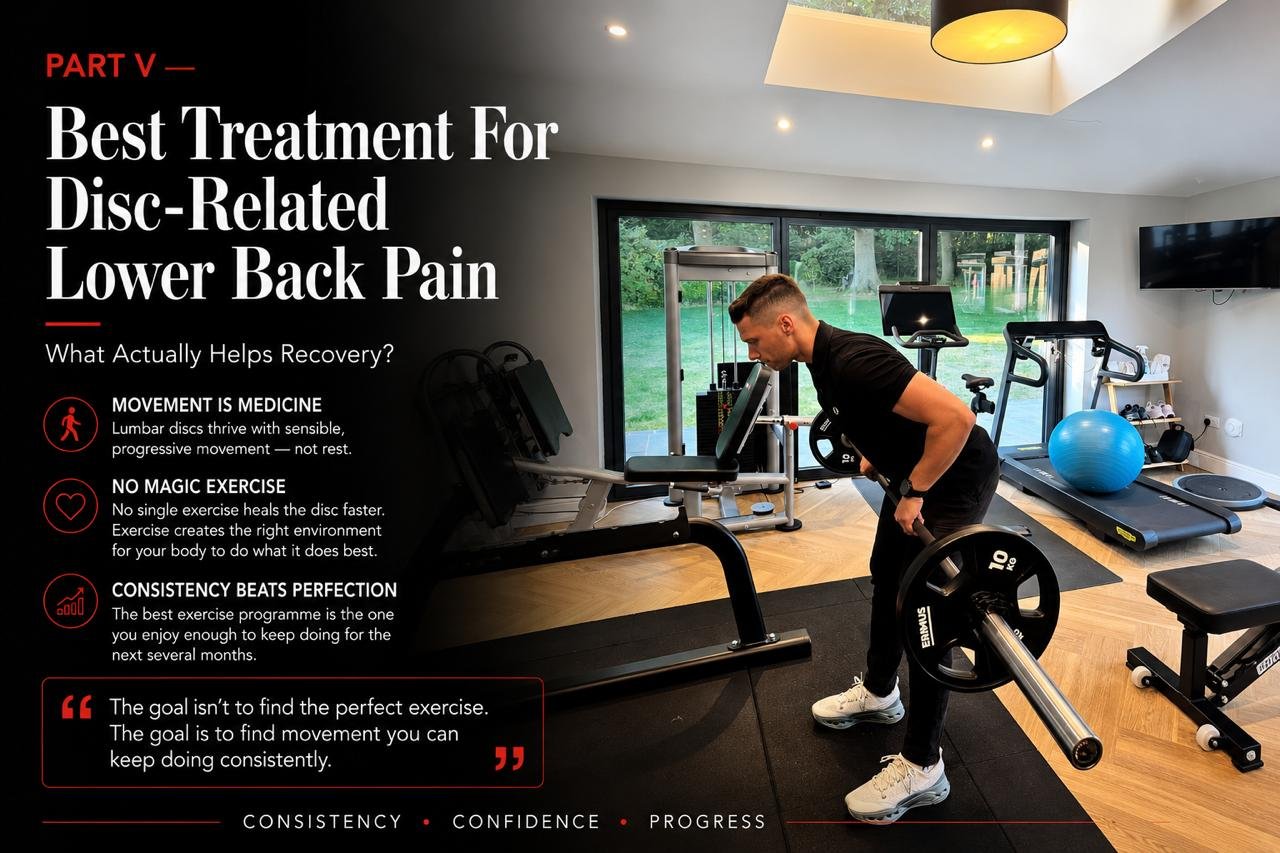
Surprisingly, lumbar discs often respond significantly better to sensible progressive movement than complete rest. This is one reason prolonged bed rest is no longer recommended for most lower back pain presentations (and, in truth, hasn’t been recommended for several years).
The body generally likes movement. Lumbar discs like movement.(I know it might not feel like it right now, but that is largely how we help them recover.)
The nervous system also likes confidence and predictability.
A common approach to disc-related lower back pain is the prescription of specific or targeted exercise programmes designed to improve mobility, strength, motor control, or directional preference. However, growing evidence suggests that no single exercise method consistently outperforms another. General exercise such as walking, gym-based strengthening, yoga, Pilates, swimming, tai chi, and other forms of regular physical activity appear to provide similar improvements in pain and function for many patients with lower back pain (Owen et al., 2020; Hayden et al., 2021; Foster et al., 2018; Shnayderman & Katz-Leurer, 2013).
At this point I feel like I understand what is probably going through your head:
“So what exercise actually helps my disc heal?” Or perhaps: “What exercise improves the rate of disc resorption?”
Interestingly, while specific exercise programmes can be extremely useful for reducing pain, improving function, restoring confidence, and helping patients return to normal activities, we currently have very little evidence that any particular exercise directly accelerates the biological healing or resorption of a lumbar disc herniation. The disc appears to heal largely through its own natural inflammatory and remodelling processes, while exercise helps create a healthier, stronger, and less sensitive environment around it (Zhong et al., 2017; Chiu et al., 2015; Foster et al., 2018).
This is actually very reassuring! It means recovery is often less about finding the one magical exercise and more about finding a form of movement that you enjoy, can perform consistently, and gradually build confidence with over time.
One sentence I find myself saying very often to patients is:”The best exercise programme is usually not the most complicated one. It is the one you are still willing to do six months from now.”
So, if you have made it this far expecting me to unveil the secret exercise that heals every disc bulge known to mankind, I apologise for the disappointment.
Going completely against my own title, the best exercise programme is usually the one you enjoy enough to keep doing consistently for the next several months. Because an average programme performed regularly will almost always outperform the perfect programme that gets abandoned after two weeks.
And perhaps that is one of the most important lessons in rehabilitation: Consistency beats perfection almost every time.
Until next time dear reader.
Hopefully this series has helped make disc-related lower back pain feel a little less confusing and a little less frightening. If you would like a personalised assessment or advice about your symptoms, you’re welcome to Contact Us to discuss how physiotherapy may be able to help.
Continue Reading
← Part IV How Long Does a Disc Bulge Take to Heal?
→ Part I (Start the Series Again)