So, how can a physiotherapist confidently identify whether your lower back pain is likely being generated by the disc itself or the surrounding disc material?
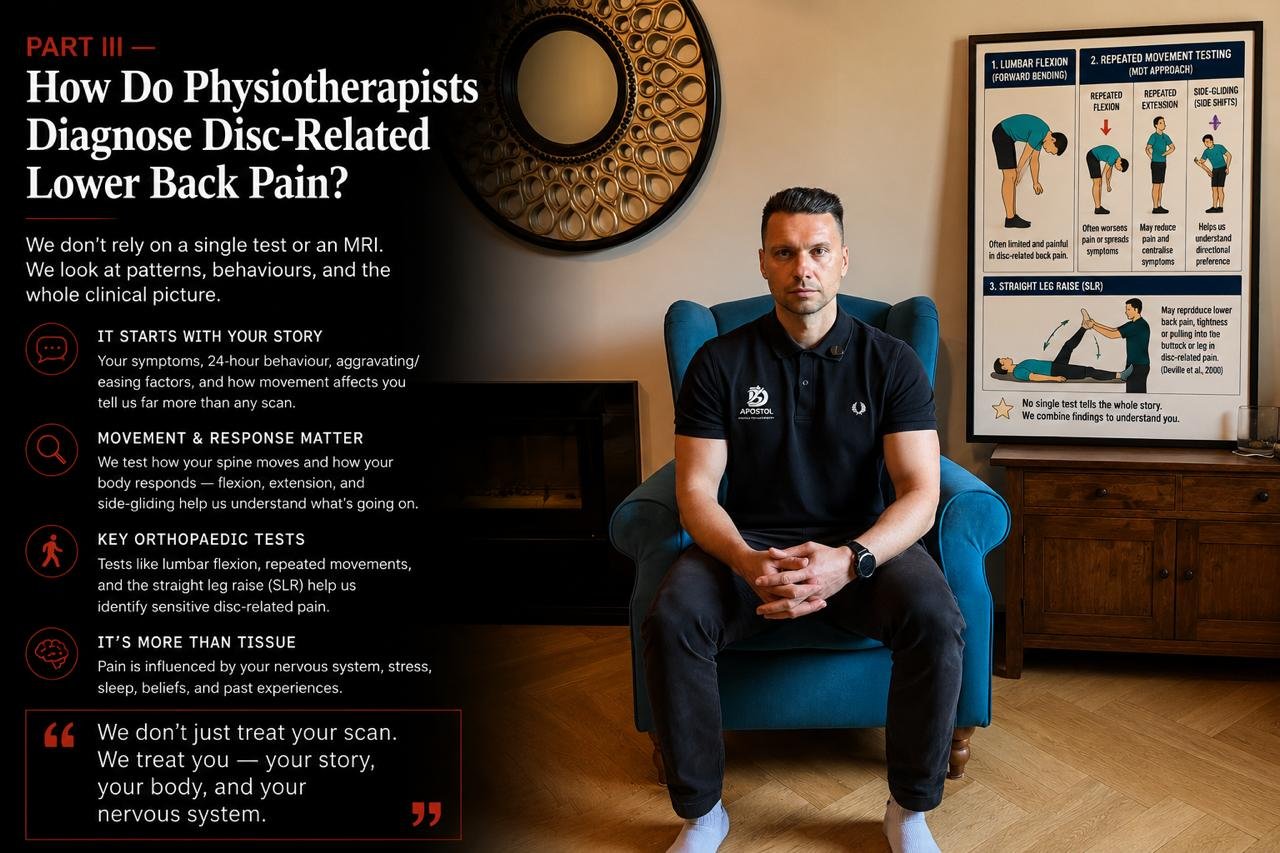
Firstly (and honestly most importantly) by listening carefully to your story. A good subjective assessment often tells us far more than the MRI scan itself. One of the biggest misconceptions around lumbar disc pain is that diagnosis relies entirely on MRI scans. In reality, disc-related lower back pain is primarily a clinical diagnosis. The patient history often tells us far more than the MRI itself (we just need to listen carefully and interpret the patient history).
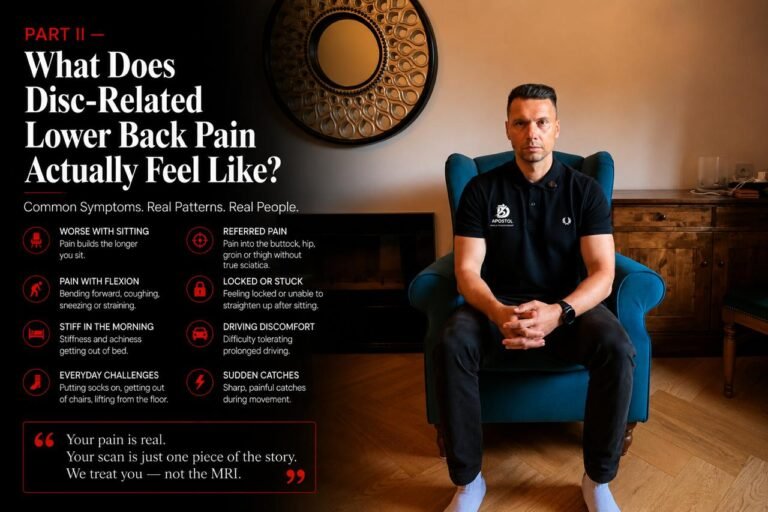
Physiotherapists will start identifying clinical patterns by exploring many of the symptoms we discussed earlier in Part II:
- pain bending forward to put shoes or socks on,
- increased pain sitting for prolonged periods,
- pain getting out of chairs,
- stiffness first thing in the morning,
- symptoms aggravated by repeated bending,
- difficulty lifting from the floor,
- increased pain with coughing, sneezing, or straining,
- and the classic: “I feel okay initially… then the longer I sit, the angrier my back becomes.”
We also look at:
- how symptoms behave throughout the day (we often call this the 24-hour behaviour pattern),
as an example : some patients with disc-related lower back pain feel particularly stiff and vulnerable first thing in the morning because discs naturally absorb fluid overnight and become slightly more pressurised after prolonged lying down.
Others feel relatively okay in the morning but progressively worsen throughout the day as sitting, bending, lifting, stress, fatigue, and cumulative loading begin irritating an already sensitive lumbar spine.
- what movements aggravate things and what positions ease things (commonly referred to as aggravating and easing factors)
as an example : Some patients feel significantly better walking. Others find prolonged standing irritating. Some respond well to extension-based movements. Others temporarily prefer slight flexion-based unloading positions
- whether symptoms centralise or peripheralise — meaning whether the pain stays more centrally around the lower back or instead starts travelling further into the buttock or leg,
- how irritable the back becomes (which is actually extremely important clinically because we do not want to aggressively assess or overload an already highly sensitive lumbar spine and accidentally create a three-day flare-up simply because we got too enthusiastic during the examination),
- whether neurological symptoms are present,
- and how movement confidence has changed since the pain started.
Now, up until this point we have mainly discussed the subjective assessment — essentially the detective work of listening carefully to your story, symptom behaviour, aggravating factors, and movement patterns.
But eventually comes the part where physiotherapists stop nodding thoughtfully and actually ask you to move. This is where the objective assessment and orthopaedic testing begin.
Now, I will try to keep this section relatively brief because it is probably considerably less exciting for you — the reader currently dealing with acute severe lower back pain and struggling to put socks on— and slightly more exciting for my fellow physiotherapists, spinal specialists, and the occasional orthopaedic test enthusiast reading this with unusual levels of enthusiasm.
Usually, somebody presenting with suspected disc-related lower back pain will first have their lumbar flexion assessed — essentially a forward bending assessment. And honestly, this is often one of the most revealing objective assessments in acute disc-related lower back pain. The expectation is that you will often be significantly limited, sometimes struggling to move your hands much past knee level before the lower back starts protesting aggressively.
Secondly, repeated movement testing will often be performed as part of the assessment. This usually involves repeatedly performing spinal movements such as:
- repeated flexion (forward bending),
- repeated extension (backward bending),
- or side-gliding movements.
The expectation is that repeated flexion will often worsen lower back pain and potentially increase referred symptoms into the buttock or leg.
Repeated extension movements may sometimes: reduce leg symptoms, centralise pain, improve mobility, or temporarily reduce lumbar discomfort.
Now, to be completely transparent it is actually rarely as textbook-perfect as social media rehabilitation videos occasionally make it appear… but it can sometimes happen clinically and be surprisingly useful when it does.
The Straight Leg Raise (SLR) test may also reproduce lower back pain, tightness, or pulling sensations into the buttock or leg in acute disc-related back pain because lifting the leg places additional tension through already sensitive lumbar disc and neural structures (Deville et al., 2000).
There are a few more orthopaedic test and various manual assessments, but I promised to keep this part short ( hopefully I’m not upsetting my physiotherapists colleagues for not going into to much details about assessment)
Importantly though: there is no single magical test that perfectly diagnoses lumbar disc pain. And also, no single symptom automatically confirms: “This is definitely your disc.” Medicine is rarely that simple. This is why physiotherapy assessment is usually based on pattern recognition and probability rather than one magical orthopaedic test that instantly reveals the secrets of your lumbar spine.
And honestly, experienced clinicians often begin developing a fairly strong hypothesis within the first few minutes simply by listening carefully to how somebody describes their symptoms, movement behaviour, aggravating factors, and fear surrounding the pain itself.
We also know that pain itself is far more complex than simple tissue damage alone.
One of Moseley’s most important contributions to modern pain science was helping clinicians and patients understand that pain is a protective output of the nervous system rather than a direct “damage meter” (Moseley, 2003; Butler & Moseley, 2013).
This does not mean:“ the pain is in your head.” The pain is very real.
But it does mean that: fear, stress, poor sleep, anxiety, beliefs, previous experiences, and nervous system sensitisation can all significantly influence how painful and threatening disc-related lower back pain feels. Which helps explain why some people with relatively modest MRI findings feel severe pain… while others with substantial lumbar disc degeneration feel almost nothing at all.
The human nervous system is incredibly protective. Sometimes slightly too protective.
Continue Reading
← PART II What Does Disc-Related Lower Back Pain Actually Feel Like?
→ PART IV How Long Does a Disc Bulge Take to Heal?