Why Pain Exists — And Why That’s Actually a Good Thing
Part I
So… you’ve now survived all three blogs about back pain and somehow decided to come back for more. Which probably means one of two things: either you genuinely want to understand pain better, or your back is still behaving suspiciously enough that you’ve entered full “I need answers” mode.
Either way, welcome back.
Since we’ve already spoken quite a lot about back pain itself, I thought it might now be useful to zoom out slightly and talk about pain in general — what pain actually is, why it exists, why it sometimes makes absolutely no sense, and why the human nervous system can occasionally behave like an overprotective parent who thinks every minor inconvenience is a medical emergency.
So let me introduce you to the fascinating world of pain physiology.
Now, I’m hoping this won’t turn into a long and boring blog… but considering we are about to discuss the brain, nervous system, danger signals, and pain science, I cannot make any legally binding promises. I will, however, do my absolute best to make it slightly more entertaining than your average medical textbook.
One of the biggest misconceptions I hear from patients is this:
“If I have pain, something serious must be damaged.”
And honestly, that belief makes complete sense. Pain feels unpleasant, threatening, frustrating, and occasionally dramatic enough to convince you your body is falling apart after one slightly ambitious gardening session.
But modern pain science has taught us something incredibly important:
Pain is not always a direct reflection of damage.
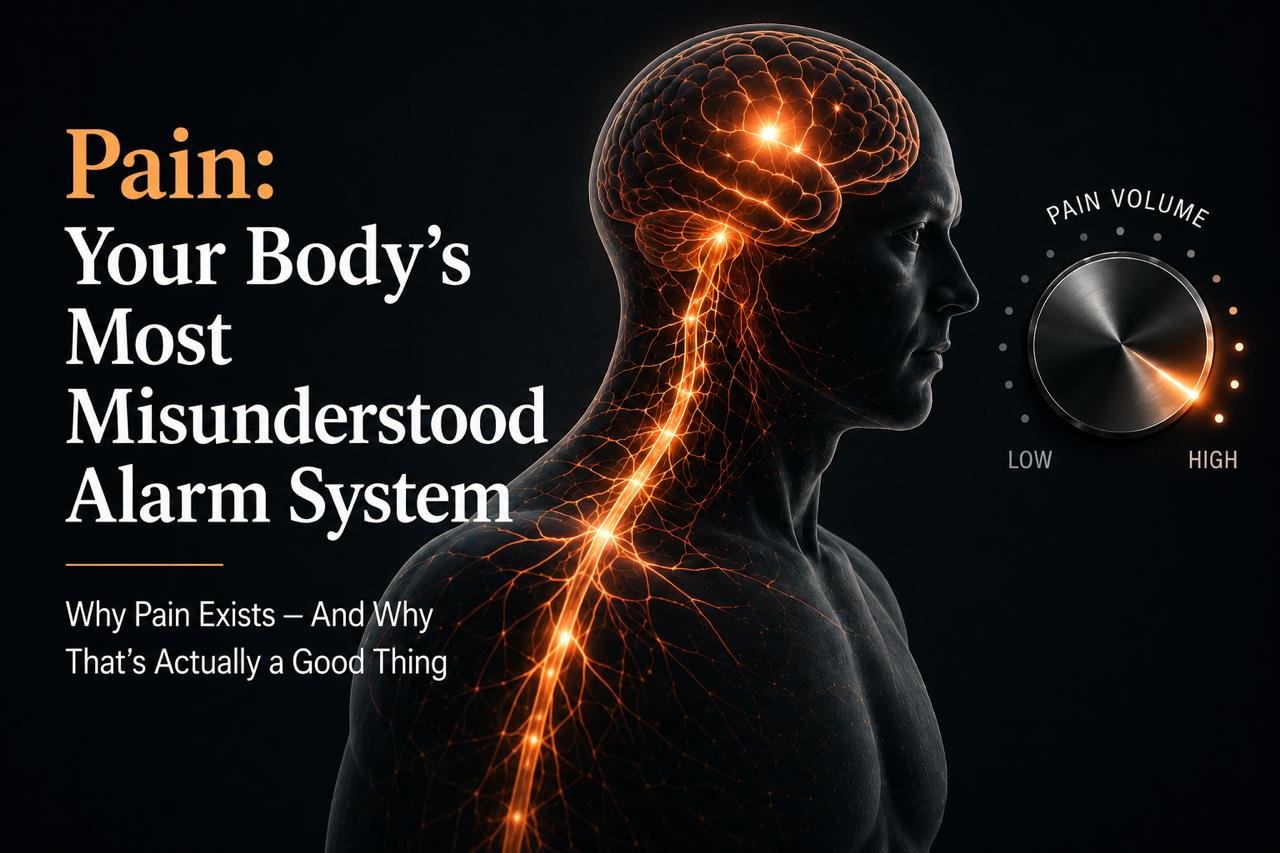
In fact, pain is one of the most sophisticated and protective systems the human body has ever developed. It exists for one reason: To Protect You! Pain is not your enemy, but rather is your body’s alarm system.
The problem is that, much like the smoke alarm in your kitchen, sometimes the system becomes a little… overenthusiastic.
When there’s an actual fire, the alarm going off makes perfect sense. It keeps you safe. But occasionally, the same alarm starts screaming because you slightly overcooked toast while simultaneously trying to answer a WhatsApp message.
Pain can behave in a very similar way. Sometimes the system is accurately warning you about tissue irritation or injury. Other times, the nervous system becomes more sensitive and protective than it really needs to be.
One of my favourite ways of explaining this to patients is through the classic “stone in the shoe” example. If you walk around with a small stone inside your trainer, the discomfort is not there because your foot is catastrophically damaged. Your body simply wants you to stop, take the shoe off, and deal with the problem before it becomes bigger. The message is protective, not destructive. Now imagine the discomfort continuing even after the stone is gone.
That is often what persistent pain looks like: the alarm system continues long after the original danger has settled. And this is where things become really interesting. Pain is not actually created inside muscles, joints, discs, or tendons themselves. Pain is produced by the brain after it interprets information coming from the body and decides whether you need protecting. That does not mean pain is “all in your head.” I will repeat again –pain it’s not in your head! But rather the brain plays an instrumental role in creating and modulating pain.
It simply means the brain acts as the body’s main security system. It constantly analyses information, previous experiences, emotions, stress levels, beliefs, sleep quality, movement confidence, and environmental factors before deciding how loudly the alarm should ring. In simple terms: your brain can turn the “pain volume knob” up or down.
Which explains why some people can have significant structural changes on scans with very little pain, while others can experience severe pain despite relatively minor tissue irritation.
Confusing? Slightly. Fascinating? Absolutely.
A different example I often use with patients is the famous “nail through the boot” case published in the British Medical Journal.
A construction worker jumped down onto a long nail on a building site. The nail went straight through his work boot and came out the other side. Naturally, he was in absolute agony. Every small movement caused severe pain and he was taken straight to the emergency department. Now here comes the fascinating part!
When doctors eventually removed the boot, they discovered that the nail had passed perfectly between his toes without causing any actual tissue damage whatsoever. No tendon injury. No fracture. No puncture wound. Nothing. Yet the pain he experienced was completely real.
And this beautifully demonstrates one of the most important — and sometimes confusing — concepts in pain science: the brain reacts not only to actual tissue damage, but also to perceived damage ,threat and danger.
Faced with all the available evidence — a nail through the shoe, intense danger, panic, shock, visual threat — the worker’s brain concluded that a serious injury must have occurred and responded proportionately by turning the “pain volume knob” up very aggressively.
The really fascinating part? The moment the worker realised his foot was actually unharmed, the severe pain disappeared almost immediately. Which tells us something incredibly important about pain: pain is always real, but it is not always an accurate measure of tissue damage.
And if you’ve made it this far into a pain physiology blog voluntarily, congratulations — you officially possess an attention span now considered endangered in modern society.
In Part II, we’ll explore what happens when the alarm system doesn’t calm down properly, why some pain becomes persistent, and why your nervous system occasionally behaves like it’s training for a full-time career in overreacting.
If pain is affecting your daily life, get in touch to discuss how physiotherapy may help.