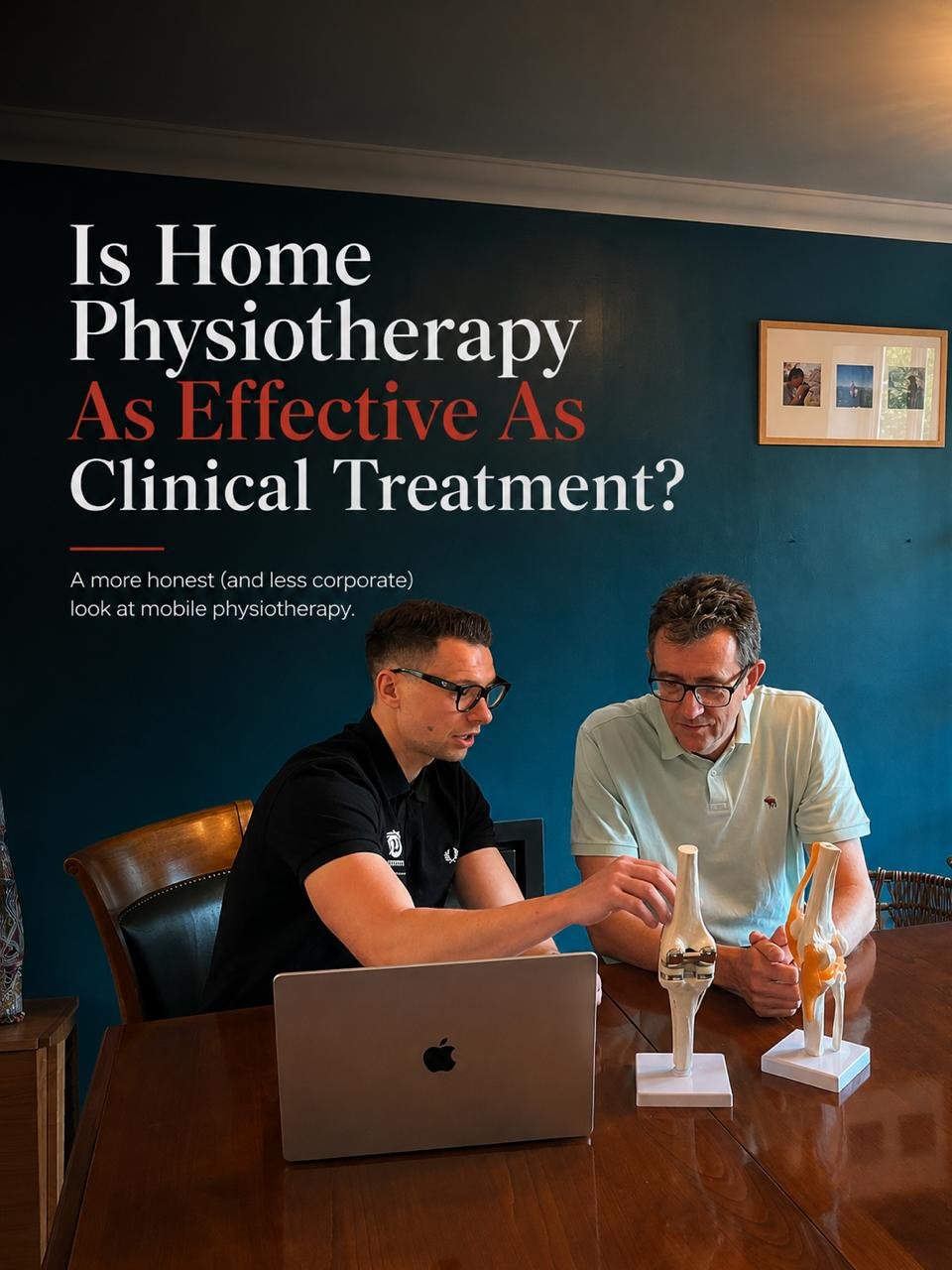
A More Honest (and Less Corporate) Look at Mobile Physiotherapy
Before we start, full transparency: I am a mobile physiotherapist, so there is probably some unavoidable bias here. I will, however, do my best to remain scientifically objective and not turn this into a 2000-word love letter to home visits.
Now, before this becomes a completely biased “mobile physiotherapy propaganda article,” it is worth mentioning that the research itself is actually quite supportive of home-based rehabilitation as well. Multiple systematic reviews over the years have shown that for many musculoskeletal and post-operative conditions, properly guided home physiotherapy can achieve outcomes very similar to clinic-based rehabilitation in terms of pain, strength, mobility, and overall function (Buhagiar et al., 2019; Zhao et al., 2023; De Klerk et al., 2023).
Which means this is not just me emotionally defending the fact that my car permanently resembles a small travelling physiotherapy department.
So, with both my bias and the research now openly acknowledged, here we go.
When most people think about physiotherapy, they usually imagine a clinic room, resistance bands hanging on a wall, somebody balancing on a Bosu ball in the corner, and a physiotherapist occasionally saying: “And how does that feel?”
So when I tell patients that I provide physiotherapy entirely through home visits across Hertfordshire, Bedfordshire, and Buckinghamshire, I still occasionally get the same slightly suspicious question: “But… is home physiotherapy actually as effective as going to a clinic?”
And honestly, it’s a fair question. Because for years we have been conditioned to believe that “proper treatment” has to happen inside a clinic building with electric beds, giant rehab gyms, and enough anatomy posters to make you feel mildly uncomfortable about how many muscles the human body actually contains.
But the reality is: for many musculoskeletal conditions, home physiotherapy is not only equally effective — in some situations, it can actually be more effective (bias alert!). And no, this is not just me trying to defend the fact that I spend a large part of my working week driving around Hertfordshire, Bedfordshire and Buckinghamshire with resistance bands and far too many weights in my car.
One of the fascinating things about treating people in their own home is that rehabilitation suddenly becomes real-life rehabilitation rather than “perfect clinic environment rehabilitation.” I genuinely only fully realised this over the past year after troubleshooting various problems directly inside patients’ homes — problems that I probably would never have properly identified or solved inside a clinic setting.
One patient with persistent lateral hip pain (GTPS) kept telling me his symptoms exploded every evening while reading on the sofa. Exercises were helping, strength was improving… yet the hip still hated him every night around 8pm.
The mystery was solved the moment I saw the sofa.
It was so deep and soft that he was essentially slowly disappearing into it every evening while compressing the side of his hip for two straight hours. A couple of pillows underneath him, a small change in position, and suddenly his gluteal tendons stopped behaving like deeply offended coworkers. This is a simple example of how real-life rehabilitation sometimes works best in a real-life environment rather than inside a perfectly symmetrical clinic chair for 45 minutes.
I had a patient after a knee replacement telling me: “Daniel, I can do the exercises… but the stairs still feel horrible.” In clinic-style testing, everything looked fairly reasonable. Then I visited his house and realised the staircase was narrow, steeper than average, had an awkward turn halfway up, and the handrail placement was about as helpful as emotional support from Ryanair customer service (sorry Ryanair). We practised directly on his stairs, changed the strategy slightly, improved confidence, and suddenly things started making much more sense.
Many patients move surprisingly well inside a clinic setting — which honestly is not shocking considering clinics are designed around health and safety regulations, ideal movement spaces, supportive chairs, clean flooring, and enough handrails to survive a small earthquake.
Real houses, unfortunately, are a completely different story. Modern furniture in particular often seems personally offended by the human spine and does not always share the same enthusiasm for our joints, tendons, and general wellbeing. At home, that is where the real story usually appears. That is where you discover the staircase they secretly dread every morning, the sofa they slowly disappear into every evening, the kitchen movement their back absolutely hates, or the awkward twisting near the washing machine that somehow recreates a full Olympic-level injury every Tuesday afternoon.
Sometimes you also realise that patients have quietly avoided going upstairs properly for three weeks after surgery simply because confidence has slowly disappeared while nobody around them noticed.
Those details matter.
A lot.
Because sometimes rehabilitation is not really about improving somebody’s squat technique under perfect clinic lighting — sometimes it is simply about helping people survive their own furniture and staircase design.
Secondly, I find that people are often far more relaxed in their own environment. Any type of clinic or hospital anxiety tends to decrease significantly when somebody is sitting comfortably in their own living room rather than under fluorescent lighting wondering whether they parked legally outside the clinic.
Assessments tend to feel more natural, movement looks far more realistic, and patients are usually less rushed, less stressed, and significantly less irritated because they did not just spend 45 minutes in traffic arriving already stiff, irritated, and emotionally exhausted before rehabilitation has even started.
Another huge advantage of home physiotherapy is consistency. Let’s be honest: when somebody is in significant pain, recovering after surgery, struggling with mobility, or balancing work, children, stress, poor sleep, and daily life… travelling to appointments can become another obstacle entirely. And unfortunately, recovery does not particularly care whether somebody was “too busy” to consistently follow their rehabilitation plan. The body still likes consistency. Interestingly, adherence and consistency remain some of the strongest predictors of successful rehabilitation outcomes across physiotherapy and exercise-based interventions (Jack et al., 2010; Argent et al., 2018).
Home physiotherapy removes many of those barriers. People are often far more likely to attend sessions regularly, follow advice, complete exercises, and stay engaged with recovery when treatment feels easier to access and less disruptive to normal life.
I have also discovered there is something strangely powerful about practising exercises in the exact same environment where people will later repeat them on their own. Once patients have already performed the movements successfully with me in the same room, on the same floor, next to the same chair or staircase, a lot of the uncertainty and hesitation around exercising suddenly disappears. It stops feeling like “rehabilitation homework” and starts feeling like something realistic, familiar, and achievable within normal daily life — which honestly removes a huge barrier to consistency.
Post-surgery, I have genuinely discovered that home physiotherapy is often almost a necessity rather than simply a convenience.For somebody recovering from a knee replacement, hip replacement, spinal surgery, Achilles rupture, severe flare-up of back pain, or simply reduced mobility in general, travelling to a clinic can sometimes feel exhausting before rehabilitation has even started.
Having to rely on somebody else to drive you to appointments several times per week can also become disruptive for partners, family members, and normal routines — while significantly limiting your own independence during a period where you have often already lost quite a lot of confidence and independence physically.
Early recovery is usually difficult enough already without turning every physiotherapy appointment into a small logistical operation. And interestingly, the early stages of rehabilitation are often far less about aggressive exercises and “pushing through pain” than people imagine. More often, the initial focus is on reassurance, confidence-building, restoring movement, calming symptoms, and gradually helping people trust their body again after surgery or injury (Vlaeyen et al., 2016; Caneiro et
al., 2020).Home physiotherapy allows all of this to happen in a familiar, calmer, and far more controlled environment — which, in my experience, often makes the entire recovery process feel significantly less overwhelming for patients.
Now, one of the biggest misconceptions I still hear is that mobile physiotherapy somehow provides a “lesser” standard of care compared to clinic treatment. As if I arrive at the house with half a physiotherapy degree, one resistance band, and positive vibes. The reality is thankfully much less dramatic. You are still seeing the same experienced clinician, using the same clinical reasoning, assessment skills, rehabilitation principles, evidence-based treatment approaches, and professional standards you would receive inside a clinic environment. The only thing that really changes is the location.
And honestly, in the vast majority of musculoskeletal conditions, successful rehabilitation is not heavily dependent on expensive machines anyway.
Most effective rehabilitation programmes are built around movement, strength, mobility, load management, confidence, education, and gradual progression — all things that can be very effectively addressed in a home environment. In reality, probably 95–99% of the equipment I regularly need for successful rehabilitation easily fits inside my car and will most likely already be brought directly to the appointment.
Interestingly, I probably fully appreciated this during the COVID pandemic while treating patients remotely through Zoom calls. At the beginning, I genuinely questioned how effective rehabilitation could really be through a laptop screen with minimal — and sometimes absolutely no — equipment available. Yet surprisingly, many patients still made very significant improvements through good education, progressive loading, movement guidance, reassurance, and consistency alone.
That experience really reinforced something important for me as a clinician: the human body responds surprisingly well to good programming, confidence-building, progressive loading, and consistency rather than depending on fancy machines that often look far more important than they actually are (Holden et al., 2020; Smith et al., 2017). And thankfully now, compared to those Zoom-call rehabilitation days, I can still arrive with a car full of genuinely useful rehabilitation equipment anyway.
One of the biggest long-term predictors of success in physiotherapy is whether people can realistically integrate rehabilitation into normal life. And this is where home physiotherapy can become incredibly powerful. Because recovery should not only happen during a 45-minute appointment under perfect clinic lighting while somebody watches you perform three beautifully controlled repetitions of an exercise you will never attempt again once you get home.
That being said, I still have patients — even now — who unfortunately do not fully adhere to their rehabilitation programme despite having all the good intentions in the world.
Because let’s be honest:
life happens.
Work happens.
Children happen.
Fatigue happens.
Netflix happens.
But what I have noticed is that when exercises are already integrated into somebody’s own environment, and patients have physically practised them successfully in the exact place they will later repeat them, the barriers to exercising tend to decrease significantly. Rehabilitation suddenly feels less like an abstract “physio homework programme” and more like something realistic, familiar, and achievable within normal daily life.
Of course, there are absolutely situations where clinic environments and specialist equipment may offer additional benefit — particularly in highly specialised neurological rehabilitation, elite athletic performance settings, or more complex rehabilitation cases requiring very specific equipment access. And equally, some patients simply prefer attending a clinic environment. Some people enjoy physically getting out of the house, changing environment, interacting socially, and separating rehabilitation from home life — especially if they already spend large amounts of time indoors due to work, pain, retirement, or recovery.
Others may have had very positive experiences in clinic settings previously and feel more motivated, focused, or reassured in that type of environment, which is completely understandable. Rehabilitation is never just about exercises and anatomy — psychology, routine, confidence, environment, and personal preference all play a role as well (Gatchel et al., 2007).
But for the vast majority of musculoskeletal conditions including back pain, neck pain, shoulder pain, arthritis, sports injuries, post-operative rehabilitation, balance problems, mobility issues, and persistent pain, home physiotherapy can still be extremely effective when delivered properly.
And perhaps one of the biggest benefits of all is something much simpler:
many people just feel more comfortable at home.
Less clinical.
Less stressful.
Less intimidating.
More personal.
Which, interestingly enough, often helps recovery itself.
Because rehabilitation is rarely just physical.
Confidence matters.
Reassurance matters.
Understanding matters.
And interestingly, modern pain science research would strongly agree with that statement (Butler & Moseley, 2013).
And if you are currently struggling with pain, stiffness, mobility issues, recovery after surgery, or persistent symptoms that are starting to affect your confidence and normal life, sometimes having somebody experienced assess you properly in your own environment can make the entire rehabilitation process feel calmer, clearer, and far less overwhelming.
Which, honestly, is often where recovery truly begins.
Daniel provides mobile physiotherapy throughout Hertfordshire, Bedfordshire and Buckinghamshire, including St Albans, Harpenden, Berkhamsted, Tring, Amersham, Milton Keynes, Hemel Hempstead, Aylesbury and surrounding areas.