I will try to keep this part relatively short, assuming you are already slightly exhausted after the long reading journey required to get here. Or perhaps you were very sensible and skipped directly to this section and the next part on treatment. If that’s the case, I would like to congratulate you for successfully avoiding approximately an hour of spinal anatomy, MRI discussions, orthopaedic testing, and my questionable attempts at humour.
Okay. You got to this point, and you have an understand of what a disc is and you also understand that your MRI finding isn’t necessary a disaster. But I suspect your burning questions is ‘How long is this going to take? How long a disc bulge takes to heal? Can it heal? (Which is a completely reasonable question).
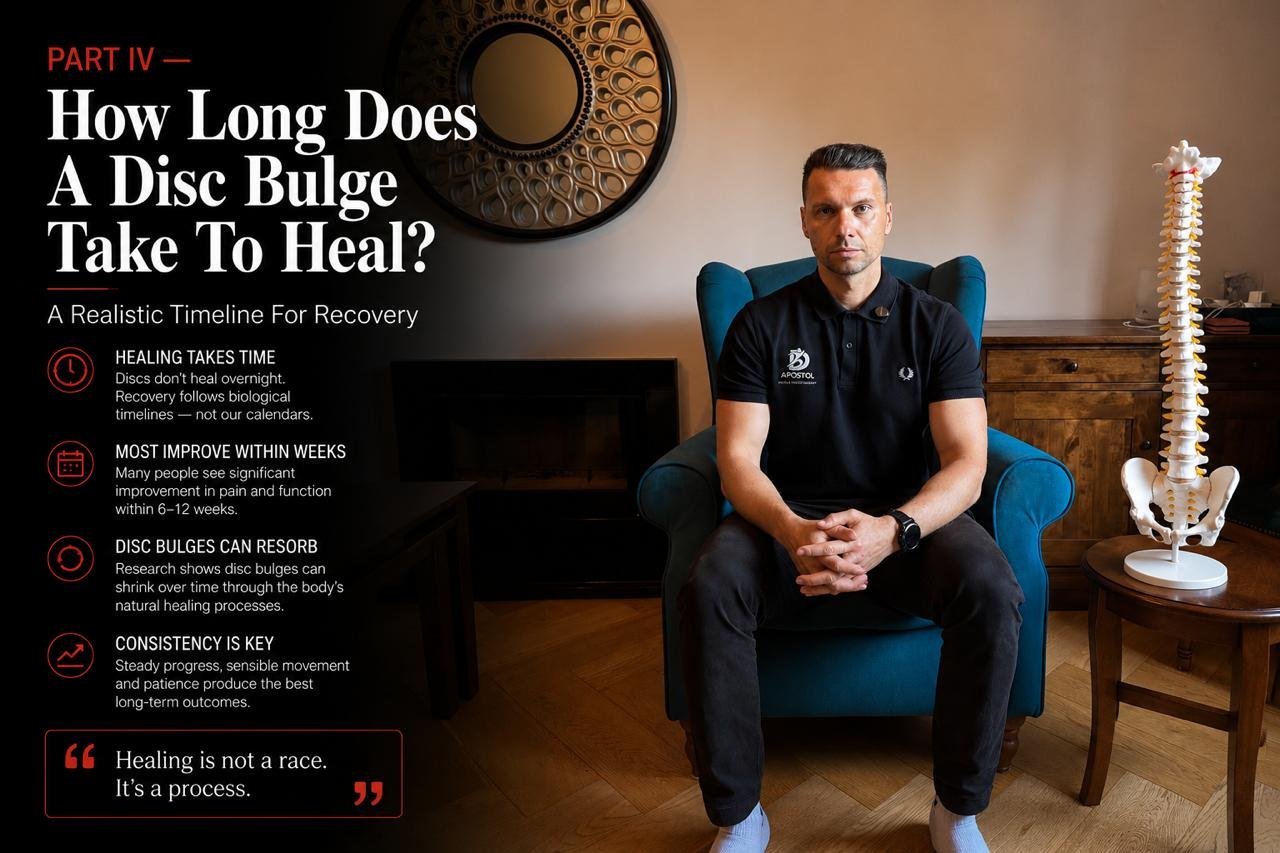
Thankfully, the prognosis for most disc-related lower back pain is generally very good. And one of the most reassuring findings in spinal research over the last decade is that many lumbar disc herniations partially — and sometimes completely — regress naturally over time (Zhong et al., 2017). Yes! The body can actually reabsorb disc material. The body is constantly adapting, remodelling, repairing, and cleaning up tissue. This is truly fascinating and completely challenges the belief out there in community that ‘once a disc bulges, it stays damaged forever.
It’s important to point out that most acute lumbar disc injuries and disc bulge flare-ups (I will explain what disc bulge flare ups are in a second) improve substantially over several weeks, particularly when people remain reasonably active and gradually resume normal movement (Hartvigsen et al., 2018; Foster et al., 2018). However, this doesn’t necessary mean that your disc is fully healed (immediately I will cover the length of time it usually takes).
Many patients assume that pain improves only when the disc physically heals. Reality is often more complicated. Pain is influenced by tissue healing, inflammation, nervous system sensitivity, sleep, stress, confidence, movement behaviour, previous experiences, and many other biological factors. Importantly though, symptoms often improve long before MRI findings do. Meaning you will feel much better long before your body with start the reabsorption process of the disc material. Your tissue healing, MRI appearance and pain will not progress/ improve at the same speed!
In fact, MRI findings can sometimes appear unchanged — and occasionally even appear slightly worse — despite patients reporting substantial clinical improvement or complete resolution of symptoms. (that’s why I’m not a huge fan of repeated and frequent MRI). This is one of the reasons repeat spinal imaging is often unnecessary unless symptoms are significantly worsening or neurological signs develop.Imagine being completely pain free yet being told that your spine looks worse than before. Imagine the conflict that creates. This is one of the reasons clinicians need to be extremely careful when discussing MRI findings. Research has shown that negative health information can influence beliefs, fear, expectations, and even pain itself — a phenomenon known as the nocebo effect (Benedetti et al., 2007; Webster et al., 2017).
So how long does it actually take for the disc material to be reabsorbed?
Well, like everything in biology and medicine it varies enormously from person to person. Studies using follow-up MRI scans suggest that measurable disc resorption can begin within a few months, but substantial changes are more commonly observed between 6 and 12 months after the initial injury (Chiu et al., 2015; Zhong et al., 2017). Many patients return to normal activities, sport, work, and daily life with minimal to no symptoms while the body continues quietly cleaning up disc material in the background (Chiu et al., 2015).
What About Flare-Ups? You may ask.
Before we discuss recovery timelines any further, it is probably worth talking about something that almost everybody with disc-related lower back pain experiences at some point: A flare-up!
Because sooner or later, it usually happens. You start feeling better. You begin moving more confidently. You walk further. You return to the gym. You spend an afternoon gardening. Or you simply sit in the car for longer than usual. (all of which you should to as normal as possible).And then suddenly your back reminds you that it still exists.
For many people this can be frightening. The immediate assumption is often: “I’ve damaged it again.” “The disc has slipped further’- this one is the most common assumption. Or -“I’ve gone back to square one.”
Thankfully, this is usually not what is happening. Research and clinical experience both suggest that most flare-ups are not a sign of new injury or fresh structural damage. More commonly, they reflect the fact that the tissues and nervous system are still sensitive as they continue progressing through the recovery process (Foster et al., 2018; Caneiro et al., 2021).
Think of it this way- healing and sensitivity are not the same thing. A tissue can be healing very well while remaining temporarily sensitive to certain loads, movements, activities, or periods of inactivity. Also (and this is very important!) the nervous system can also remain slightly overprotective for a period of time following an episode of severe pain- meaning it might trigger the alarm (pain) sometimes from the smallest of insult -something that pre injury wouldn’t had trigger any alarm (pain) signal.
This is one of the reasons flare-ups can occur despite the fact that overall recovery is moving in the right direction. In fact, many patients who eventually make an excellent recovery experience several flare-ups along the way.
Recovery often looks less like a straight line and more like a slightly chaotic stock market chart. Recovery often looks more like this Pain → Better → Worse → Better → Slightly Worse → Better Again → Why Is It Hurting Today? → Better → Recovery.
A flare-up does not necessarily mean that you have damaged your spine. It does not necessarily mean the disc has become worse. And it certainly does not mean that all the progress you have made has suddenly disappeared overnight. More often than
not, it simply means your back is reminding you that recovery is still a process rather than a single event.
Most people with disc-related lower back pain improve. Some improve quickly. Some improve slowly. Some need reassurance. Some need rehabilitation. Most need both. But the overwhelming majority recover far better than they initially expect.
Continue Reading
← Part III How Do Physiotherapists Diagnose Disc-Related Lower Back Pain?